Popular Posts

Tuesday, 11 March 2014

Chemistry Of Dyes

CHEMISTRY OF DYES

Chemistry of Dyes
Chemistry of Dyes
A dye is a colored substance that has an affinity to the substrate to which it is being applied. It is an ionizing and aromatic organic compound, with Chromophores as a major component. Their structures have Aryl rings that have delocalized electron systems. These structures are said to be responsible for the absorption of electromagnetic radiation that has varying wavelengths, based upon the energy of the electron clouds.


History of Dyes
History of Dyes

History of Dyes

Dyes usage was started in 2600 BC in china and followed by
  • 715 BC Wool dyeing established as craft in Rome
  • 55 BC Romans found painted people “picti”
  • 2ND and 3RD Centuries AD Roman graves found with madder and indigo dyed textiles
  • 1200′s Rucellia, of Florence, rediscovered the ancient art of making purple dye from lichens
  • 1321 Brazilwood was first mentioned as a dye
  • 1507 France, Holland and Germany begin the cultivation of dye plants as an industry
  • 1630 Drebbel produced a new brilliant red dye from sources like cochineal and tin
  • 1774 Scheele discovered chlorine destroyed vegetable colors
  • 1774 Prussian Blue and Sulfuric acid are started available in commercial market
  • 1775 Bancroft introduced the use of quercitron bark as a natural dye
  • 1834 Runge, a German chemist developed aniline dyes
  • 1856 William Henry Perkin discovered the first synthetic dye “Mauve”
  • 1858-59 Verguin discovered Magenta (fuchsin) dye
  • 1861 Lauth discovered basic dye called Methyl violet
  • 1862 Martius and Lightfoot developed Bismarck Brown
  • 1863 Lightfoot developed Aniline Black
  • 1868 Graebe and Liebermann produced alizarin dye
  • 1872 Lauth and Baubigny developed Methyl Green
  • 1873 Groissant and Bretonniere produced Cachou de Laval sulphur dye
  • 1876 Methyl Blue discovered by Caro
  • 1877 Dobner & Fisher discovered Malachite Green discovered
  • 1878 Biebrich Scarlet invented red acid dye
  • 1878 von Baeyer synthesized synthetic indigo
  • 1880 Thomas and Holliday synthesized azo dye
  • 1884 Bottiger discovered Congo Red [cotton dye]
  • 1885 Duisberg produced Benzopurpurine direct dye
  • 1885 von Gallois and Ullrich discovered Para Red dye
  • 1901 Rene Bohn invented and patented Indanthrene Blue RS
  • 1901 Bohn Flanthrene vat dye
  • 1905 Freidlander discovered Thio-indigo Red
  • 1908 Cassella developed Hydron Blue
  • 1921 Bader developed soluble vat colors
  • 1924 Baeyer and Sunder companies produced Indigosol 0
  • 1951 Geigy introduced Irgalan dyes
  • 1956 Eastman Kodak introduced Verel
  • 1957 CIBA introduces Cibacrons reactive dyes

Dye manufacturing Process

Dyeing process

Dyeing is the method of adding color to textile products like fibers, yarns, fabrics, leather, plastics, paint, printing and many others. Dyeing is normally done in a special solution containing dyes and particular chemical material.

Dyeing process of textiles

In textile dyeing process widely used chemicals like

Classification of dyes

Classification of dyes

Dyes are classified based on following factors
  • Chemical composition
  • Nature of nuclear structure
  • Various industrial uses
  • Sources of origin
  • Miscellaneous factors

Dyes which are classified based on chemical composition are

  • Acridine dyes
  • Anthraquinone dyes
  • Arylmethane dyes
  • Azo dyes
  • Cyanine dyes
  • Diazonium dyes
  • Nitro dyes
  • Nitroso dyes
  • Phthalocyanine dyes
  • Azin dyes
  • Eurhodin dyes
  • Safranin dyes
  • Xanthene dyes
  • Indophenol dyes
  • Oxazin dyes
  • Oxazone dyes
  • Thiazin dyes
  • Thiazole dyes
  • Fluorene dyes
  • Rhodamine dyes
  • Pyronin dyes

Dyes which are classified based on industrial uses are

Acid dyes - water-soluble anionic dyes applied from acidic dye baths to nylon, silk, wool, modified acrylics
Azoic dyes – contains azo group
Basic dyes – water-soluble cationic dyes
Direct dyes – water-soluble anionic dyes applied to dyeing of cotton, regenerated cellulose, paper and leather
Disperse dyes – water-insoluble nonionic dyes
Reactive dyes – used in materials like cotton, rayon, nylons
Solvent dyes – water-insoluble, soluble in alcohols, chlorinated hydrocarbons, or liquid ammonia
Sulfur dyes – water-insoluble, low cost, good fastness dyes
Vat dyes – insoluble complex polycyclic molecules
Mordant dyes – used to improve the fastness of the dye against water

 Dyes which are classified based on Sources of origin are


Dyes which are classified based on miscellaneous factors

  • Fluorescent Dyes
  • Oxidation Dyes
  • Fuel Dyes
  • Leather Dyes
  • Optical Brighteners
  • Leuco Dyes
  • Sublimation Dyes
  • Smoke Dyes
  • Inkjet Dyes
  • Solvent Dyes

Sunday, 9 March 2014

Manufacturing of chlorine, sodium hydroxide, hydrogen using membrane cell

The Membrane Cell


The membrane is made from a polymer which only allows positive ions to pass through it. That means that the only the sodium ions from the sodium chloride solution can pass through the membrane - and not the chloride ions. The advantage of this is that the sodium hydroxide solution being formed in the right-hand compartment never gets contaminated with any sodium chloride solution. The sodium chloride solution being used has to be pure. If it contained any other metal ions, these would also pass through the membrane and so contaminate the sodium hydroxide solution.

Production of the chlorine

Chlorine is produced at the titanium anode according to the equation:

2Cl-(aq) - 2e-   -->  Cl2 (g)

It is contaminated with some oxygen because of the reaction:

4OH-(aq) - 4e-  -->   2H2(l) + O2 (g)

The chlorine is purified by liquifying it under pressure. The oxygen stays as a gas when it is compressed at ordinary temperatures.

Production of the hydrogen


The hydrogen is produced at the nickel cathode:

2H+(aq) + 2e- -->  H2(g)


Production of the sodium hydroxide


An approximately 30 per cent solution of sodium hydroxide solution is also produced at the cathode (see above - in the background chemistry section - for the explanation of what happens at the cathode).


Manufacturing of chlorine,sodium hydroxide using diaphragm cell

The Diaphragm Cell

The diaphragm is made of a porous mixture of asbestos and polymers. The solution can seep through it from the anode compartment into the cathode side. Notice that there is a higher level of liquid on the anode side. That makes sure that the flow of liquid is always from left to right - preventing any of the sodium hydroxide solution formed finding its way back to where chlorine is being produced.

Production of the chlorine

Chlorine is produced at the titanium anode according to the equation:

2Cl-(aq) - 2e-   -->   Cl2 (g)

It is contaminated with some oxygen because of the reaction:

4OH-(aq) - 4e-   --> 2H2(l) + O2 (g)

The chlorine is purified by liquifying it under pressure. The oxygen stays as a gas when it is compressed at ordinary temperatures.


Production of the hydrogen

The hydrogen is produced at the steel cathode:

2H+(aq) + 2e- ->   H2(g)


Production of the sodium hydroxide

A dilute solution of sodium hydroxide solution is also produced at the cathode. It is highly contaminated with unchanged sodium chloride solution. The sodium hydroxide solution leaving the cell is concentrated by evaporation. During this process, most of the sodium chloride crystallises out as solid salt. The salt can be separated, dissolved in water, and passed through the cell again. Even after concentration, the sodium hydroxide will still contain a small percentage of sodium chloride.


Friday, 7 March 2014

CHEMISTRY OF ADHESIVES & SEALANTS – WORLD OF CHEMICALS

CHEMISTRY OF ADHESIVES & SEALANTS – WORLD OF CHEMICALS

adhesives, selants
adhesives, selants
An adhesive is a material used for holding two surfaces together. An adhesive must wet the surfaces, adhere to the surfaces, and by surface attachment that resists separation. Inorganic substances such as portland cement also can be considered adhesives. Natural adhesives have been known since antiquity. In the performance of adhesive joints, the physical and chemical properties of the adhesive are the most important factors.

Types of adhesive raw materials

  • Starch
  • Dextrin
  • Gelatin
  • Asphalt
  • Bitumen
  • Cellulose nitrate
  • Cellulose acetate
  • Methyl cellulose
  • Ethyl cellulose
  • Polyvinyl acetate
  • Polyvinyl alcohol
  • Polyvinyl butyral
  • Polyvinyl ether
  • Polyvinyl chloride
  • Cyanoacrylate
  • Polychloroprene
  • Styrene
  • Polyisobutylene
  • Polyurethane
  • Acrylonitrile
  • Silicone
  • Melamine
  • Urea
  • Resorcinol
  • Polyamide
  • Polybenzimidazole
  • Polyethylenimine
Adhesives
Adhesives

Mechanism of adhesion process

The main mechanism of adhesion is explained by the adsorption theory.

Adsorption theory

Adsorption theory can be defined as substances stick because of intimate intermolecular contact. In adhesive joints this contact is attained by intermolecular or valence forces exerted by molecules in the surface layers of the adhesive and adherend.
In addition to adsorption, four other mechanisms of adhesion have been proposed.

Mechanical interlocking

It occurs when adhesive flows into pores in the adherend surface or around projections on the surface.

Interdiffusion

Interdiffusion results when liquid adhesive dissolves and diffuses into adherend materials.

Adsorption & Surface Reaction

In this process bonding occurs when adhesive molecules adsorb onto a solid surface and chemically react with it.

 Electronic/electrostatic attraction

This theory suggests that electrostatic forces develop at an interface between materials with differing electronic band structures

Sealants

adhesives
adhesives
A sealant is the viscous material that has little or no flow characteristics and stay where they are applied or thin and runny so as to allow it to penetrate the substrate by means of capillary action.
The main difference between adhesives and sealants is that sealants typically have lower strength and higher elongation than do adhesives.
Sealants fall between higher-strength adhesives at one end and extremely low-strength putties and caulks at the other. Sealants fill a gap between two or more substrates. It forms a barrier through the physical properties of the sealant itself and by adhesion to the substrate. Sealants maintain sealing properties for the expected lifetime, service conditions and environments.
Dental sealants are a dental treatment consisting of applying a plastic material to one or more teeth, for the purpose of preventing dental caries (cavities) or other forms of tooth decay.

CHEMISTRY OF GLASS – WORLD OF CHEMICALS

Glass

Glass Chemistry
Glass Chemistry
Besides to usage of ceramics in laboratories glass [glassware] also used in the different laboratories. Other places where glass is used include windscreens of cars, windows in houses, furniture, television sets, soft drink bottles, water drinking glass, and spectacles
Glass is an amorphous solid material that exhibits a glass transition.  It is a state of matter in which the atoms and molecules are locked into place, but instead of forming neat, orderly crystals, they arrange themselves randomly.
Glass is having similarity with ceramics in terms of their properties like durability, strength and brittleness, high electrical and thermal resistance, and lack of chemical reactivity.
Glass is made up of silica (SiO2). Following are the other components of silica
Glass chemistry
Glass chemistry

History of glass

First true glass was made in coastal north Syria
The story of glass dates back to ancient Egypt where glass-making became popular during the late Bronze Age.
Anglo-Saxon period glass was a luxury material across England
In 10th centaury stained glass came to usage
In 1330 crown glass was produced in Rouen
In 14th and 19th centauries stained glass employed in building purposes
In 1843 Henry Bessemer invented float glass
In 120th centaury reinforced glass and glass bricks came to usage
Colored glasses are due to inclusion of ions of chemical elements like iron (Fe), cobalt (Co), nickel (Ni), copper (Cu), chromium (Cr), and manganese (Mn)

Glass preparation

Glass production mechanisim
Glass production
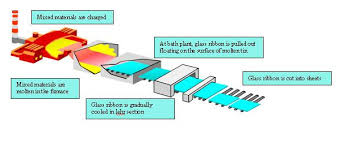
The main constituent of flat Glass is SiO2. This has a high melting temperature in the region of 1700 degrees C. The basic building block of silica has a tetrahedral pyramid shape with silicon at its centre linked symmetrically to four oxygen atoms at its corners.
On cooling molten silica quickly, a random organised network of these tetrahedra is formed, linked at their corners, to give an amorphous material known as vitreous silica.
High melting point and viscosity of silica can be reduced by the addition of sodium oxide. Here sodium oxide works as flux. Sodium oxide used in the form of a carbonate and the sodium-oxygen atoms enter the silicon-oxygen network.
These network modifiers make the structures more complex so that when the components are melted together. In the glass making process, the cooling rate is arranged such that viscosity increases and the mobility of the atoms are hindered thus preventing arrangements and crystallization from occurring.

Applications

Glass manufacturing
Glass manufacturing
Flat glass is used in glazing in buildings, to car windscreens, doors and mirrors.
Container glass extensively used in beer, wine, spirits, juices, food, cosmetics.
Borosilicate glass possesses good chemical and thermal shock resistance which make it ideal for laboratory equipment and various forms of ovenware.