Popular Posts

Thursday, 19 December 2013

Chemistry behind plastics, rubber, resins, its history, evolution, production, industrial applications

Plastics 


Plastics are made up of polymers, but some polymers like biopolymers are not plastics. Plastic materials are being used in day to day life like computers, pen, mobile phones, compact discs, pendrive, and toothbrushes etc.

Plastic is defined as any synthetic or semi-synthetic organic material that can be shaped or molded into any form. Chemical composition of plastics includes chains of carbon, oxygen, sulfur or nitrogen.

History of plastics

In 1284 naturally made plastic compounds from horn and tortoiseshell were identified

1820 plastic timeline

In 1823, Scottish chemist Charles Macintosh discovered rubber.
In 1845, Henry Bewley produced natural rubber from plant gutta percha
In 1850, first submarine telegraph cable in gutta percha laid between Dover and Calais
In 1862, Londoner Alexander Parkes unveiled first man-made Parkesine plastic compound
In 1869, John W. Hyatt invented Celluloid [colorless flammable material]
In 1872, Hyatt brothers patented first plastics injection moulding machine
In 1880 cellulose nitrate replacing horn as the preferred material for combs
In 1885, George Eastman Kodak patents machine for producing continuous photographic film based on cellulose nitrate.

1900 plastic timeline

In 1908, Jacques E. Brandenberger invented Cellophane [transparent cellulose material]
In 1909, Casein plastics, derived from milk, developed by Erinoid.
In 1909, H. Baekeland created first fully synthetic plastic product called Bakelite
In 1916, Rolls Royce begins to use phenol formaldehyde in its car interiors.
In 1920, Polyvinyl chloride or PVC was created.
In 1925, Plastic term was coined.
In 1930, in this year scotch tape was invented by 3M company
In 1933, Fawcett and Gibson discovered polyethylene material
In 1938, first toothbrush with nylons tufts manufactured.
In 1939, in this year nylon created.
In 1942, Dr Harry Coover discovered Super Glue (methyl cyanoacrylate).
In 1948, Acrylonitrile-butadiene-styrene (ABS) produced.
In 1949, Tupperware material made from low density polyethylene.
In 1949, DuPont invented Lycra product which is based on polyurethane.
In 1953, Lexan plastic material was invented by Daniel Fox.
In 1959 Barbie Doll unveiled at American International Toy Fair.
In 1965 DuPont released products with the trade name of Kevlar.
In 1973, Polyethylene terephthalate beverage bottles introduced.
In 1988, triangular recycling symbols relating to plastics were introduced.

2000 to 2022 plastic timeline

In 2003 Recovinyl [it is a European PVC recycling system] was established
2005 in this year NASA explores the advantages of a polyethylene based material RFX1 [RFX1 used for spaceship construction]
In 2011, vinylplus - sustainability programme established
In 2012 PVC fabric used in the construction of London Olympic venues
2020 PVC products production will reaches to 800,000 tones per year
2022 in this year the FIFA world cup qatar showcase stadium is planning to use super reflective, triangulated PVC fabric to create a zero carbon.

Manufacturing process of plastics

Preparation of raw materials
Preparation of monomer
Polymerization process
Conversion of polymer resins to plastic products

In the process of converting polymer resins to plastic product following steps are involved

  • Extrusion
  • Injection molding
  • Blow molding
  • Rotational molding

Applications of plastics

Plastics are widely used in following industrial sectors for various purposes
Textile industry – polyester used for making of some cloths
Packaging industry - Polyethylene terephthalate chemical used in carbonated drinks bottles, peanut butter jars, plastic film, microwavable packaging

Plastic also used in

  • Supermarket bags
  • Window frames, outdoor furniture
  • Toothbrush bristles
  • Traffic lights
  • Cushioning foams
  • Thermal insulation foams
  • Surface coatings

Rubber


Rubber is considered as elastic substance, which is obtained from the exudations of certain tropical plants (natural rubber) or derived from petroleum and natural gas. Rubber also termed as elastomer, a type of polymer. In 1770 Joseph Priestley coined the term rubber.

Rubber is divided into two groups based on its origin

Natural rubber – used in racing car tires, bus tires, truck tires
Synthetic rubber – examples butadiene rubber, styrene butadiene rubber, neoprene

Physical & Chemical properties of rubber

Did your ever wonder how rubber will stretch?

Before you want to know the reason one should know the physical and chemicals properties of rubber

Physical properties

In relaxed state, rubber is in the form of long, coiled-up chains. By stretching of rubber the all chains will come very close as result, kinetic energy exerted in the form of heat. In chain elongation process entropy and temperatures required during this process are increases. When chain in relaxed state both entropy and temperatures decreases.

Relaxation of a stretched rubber band is thus driven by a decrease in entropy and temperature, and the force experienced is a result of the cooling of the material being converted to potential energy. The material undergoes adiabatic cooling during contraction.

Vulcanization of rubber creates disulfide bonds between chains. The result is that the chains tighten more quickly for a given strain, thereby increasing the elastic force constant and making rubber harder and less extensible.

Chemical properties

Like plastic, rubber is also a type of polymer, made of subunits called monomers. In rubber, the monomer is isoprene. As the latex dries, the isoprene molecules mass together and one isoprene molecule attacks a carbon-carbon double bond of a neighboring molecule. One of the double bonds breaks and the electrons repositioned to form a bond between the two isoprene molecules.

The process continues until long strands of many isoprene molecules linked like a chain. This long chain of strands is called as polyisoprene polymer. As the drying continues, the polyisoprene strands stick together by forming electrostatic bonds. The attraction between these strands holds the rubber fibers together and allows them to stretch and to recover.

Synthetic rubber production

Emulsion polymerization is the widely used method to produce synthetic rubber.

Emulsion polymerization

Emulsion polymerization is a type of radical polymerization process that usually starts with an emulsion incorporating water, monomer, and surfactant. The most common type of emulsion polymerization is an oil-in-water emulsion, in which droplets of monomer (the oil) are emulsified (with surfactants) in a continuous phase of water.

In emulsion polymerization, the monomers are emulsified in water with a suitable soap and a water-soluble free-radical catalyst is added to induce polymerization. After polymerization has reached the desired level, the reaction is stopped by adding a radical inhibitor. About 10 per cent of synthetic elastomer produced through emulsion technique. The rest is coagulated with acidified brine, washed, dried, and pressed into 35-kg bales.

Resins


Resin is a natural or synthetic hydrocarbon secreted many plants, particularly coniferous trees. Its applications ranging from art to polymer production and many consumers interact with products that contain it on a daily basis.

The resin produced by most plants is a viscous liquid, composed mainly of volatile fluid terpenes, with lesser components of dissolved non-volatile solids which make resin thick and sticky. The most common terpenes in resin are the bicyclic terpenes alpha-pinene,beta-pinene, delta-3 carene and sabinene, the monocyclic terpenes limonene and terpinolene, and smaller amounts of the tricyclic sesquiterpenes, longifolene, caryophyllene and delta-cadinene. Some resins also contain a high proportion of resin acids.

Types of resins

Oleoresins are naturally occurring mixtures of oil and a resin. Oleoresins contain benzoic acid or cinnamic acid.

Formaldehyde resin is a synthetic resin product made with formaldehyde. This product is used in a wide variety of settings and industries, and is one of the oldest synthetic resins around.Plastic resins are made by heating hydrocarbons. Plastic resins are used to make many different kinds of products.

Epoxy resins are created by transforming liquid polyethers into infusible solids through a special curing process. Epoxy resins fiber optics, optoelectronics, and dentistry.

Silicone resins are a type of silicone material which is formed by branched, cage-like oligosiloxanes with the general formula of RnSiXmOy.

Applications of resins

Resins is used in following sectors

  • Varnishes
  • Adhesives
  • Therapeutic purposes
  • Musical instruments
  • In making sculptures
  • Motors
  • Generators
  • Transformers
  • Switchgear
  • Bushings
  • Insulators
  • Integrated circuits
  • Transistors
  • Hybrid circuits
  • Printed circuit boards

Thursday, 12 December 2013

Chemistry of ceramics, glass, adhesives and sealants and its industrial applications

Ceramics

Every day in our homes we are using smooth, beautiful designed coffee cups, tea cups, plates and bowls. These should be handled carefully and proper maintenance required. Even in laboratories mortar and pestles lab ware manufactured by using special kind of material. All these kind of utensils and lab ware aremade up of ceramic.

Ceramic materials are non-metallic, inorganic compounds-primarily compounds of oxygen, carbon, nitrogen, boron, and silicon. Ceramics includes the manufacture of earthenware, porcelain, bricks, sewer pipe and electrical insulators.

Ceramics was started using in time of Neolithic time. In this 20th centaury their uses reached to bowls to semiconductors. Some kind of advanced ceramics include alumina ceramics are using in missiles and rocket nose cones. Other advanced usage includes uranium dioxide (UO2) ceramics used in nuclear power plant elements, laser materials, ceramic capacitors, piezoelectric materials.

Ceramics making process

Ceramics is made up of clay, talc, silica, feldspar, organometallic compounds, silicon carbide, alumina, and barium titanate.

Process

First natural material like clay is required to be heated to high temperatures. Clay consists of a large number of very tiny flat plates, stacked together by thin layers of water. The water allows the plates to attach together and allowing the plates to slide past one another. As a result, clay is easily molded into various shapes.

High temperatures make drying water inside the clay and allow bonds to form between plates, holding and promoting the formation of a hard solid. Binders such as bone ash are sometimes added to the clay to promote sturdy bond formation, which makes the ceramic resistant to breakage.

Ceramic is also made by mixing clay and cements and hardening it by heating it to high temperatures. Advanced technique of making of ceramics used sol-gel process.

Ceramics contain following properties

  • Chemical properties
  • Mechanical properties
  • Physical properties
  • Thermal properties
  • Electrical properties
  • Magnetic properties

Chemical properties

Industrial ceramics are made up of compounds of oxygen, heavy metals, carbon, boron, nitrogen, silicon. Ceramics do not react with most liquids, gases, alkalies, and acids.

Physical properties

Ceramics are smooth, lighter in weight, hard and resistance to abrasions.

Electrical properties

Ceramics are also used as insulators. Certain ceramics, such as porcelain, act as insulators at lower temperatures but in contrast they will conduct electricity at higher temperatures.

Ceramics applications

Ceramics used for making strong, hard, and abrasion-resistant materials.

In textile industry ceramics resist the cutting action of fibers traveling through these guides at high speed.

Scientists discovered a family of superconductive copper-oxide-based ceramics.


Glass

Besides to usage of ceramics in laboratories glass [glassware] also used in the different laboratories. Other places where glass is used include windscreens of cars, windows in houses, furniture, television sets, soft drink bottles, water drinking glass, and spectacles

Glass is an amorphous solid material that exhibits a glass transition.  It is a state of matter in which the atoms and molecules are locked into place, but instead of forming neat, orderly crystals, they arrange themselves randomly.

Glass is having similarity with ceramics in terms of their properties like durability, strength and brittleness, high electrical and thermal resistance, and lack of chemical reactivity.

Glass is made up of silica (SiO2). Following are the other components of silica


History of glass

First true glass was made in coastal north Syria

The story of glass dates back to ancient Egypt where glass-making became popular during the late Bronze Age.

Anglo-Saxon period glass was a luxury material across England

In 10th centaury stained glass came to usage
In 1330 crown glass was produced in Rouen
In 14th and 19th centauries stained glass employed in building purposes
In 1843 Henry Bessemer invented float glass
In 120th centaury reinforced glass and glass bricks came to usage

Colored glasses are due to inclusion of ions of chemical elements like iron (Fe), cobalt (Co), nickel (Ni), copper (Cu), chromium (Cr), and manganese (Mn)

Glass preparation

The main constituent of flat Glass is SiO2. This has a high melting temperature in the region of 1700 degrees C. The basic building block of silica has a tetrahedral pyramid shape with silicon at its centre linked symmetrically to four oxygen atoms at its corners.

On cooling molten silica quickly, a random organised network of these tetrahedra is formed, linked at their corners, to give an amorphous material known as vitreous silica.

High melting point and viscosity of silica can be reduced by the addition of sodium oxide. Here sodium oxide works as flux. Sodium oxide used in the form of a carbonate and the sodium-oxygen atoms enter the silicon-oxygen network.

These network modifiers make the structures more complex so that when the components are melted together. In the glass making process, the cooling rate is arranged such that viscosity increases and the mobility of the atoms are hindered thus preventing arrangements and crystallization from occurring.

Applications

Flat glass is used in glazing in buildings, to car windscreens, doors and mirrors.

Container glass extensively used in beer, wine, spirits, juices, food, cosmetics.

Borosilicate glass possesses good chemical and thermal shock resistance which make it ideal for laboratory equipment and various forms of ovenware.


Adhesives & Sealants

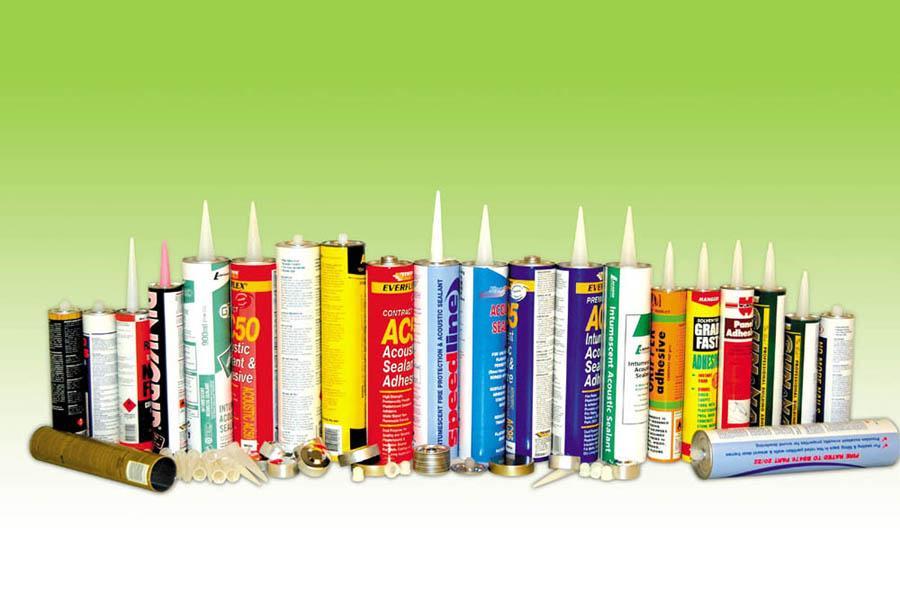
An adhesive is a material used for holding two surfaces together. An adhesive must wet the surfaces, adhere to the surfaces, and by surface attachment that resists separation. Inorganic substances such as portland cement also can be considered adhesives. Natural adhesives have been known since antiquity. In the performance of adhesive joints, the physical and chemical properties of the adhesive are the most important factors.

Types of adhesive raw materials

  • Starch
  • Dextrin
  • Gelatin
  • Asphalt
  • Bitumen
  • Cellulose nitrate
  • Cellulose acetate
  • Methyl cellulose
  • Ethyl cellulose
  • Polyvinyl acetate
  • Polyvinyl alcohol
  • Polyvinyl butyral
  • Polyvinyl ether
  • Polyvinyl chloride
  • Cyanoacrylate
  • Polychloroprene
  • Styrene
  • Polyisobutylene
  • Polyurethane
  • Acrylonitrile
  • Silicone
  • Melamine
  • Urea
  • Resorcinol
  • Polyamide
  • Polybenzimidazole
  • Polyethylenimine

Mechanism of adhesion process

The main mechanism of adhesion is explained by the adsorption theory.

Adsorption theory

Adsorption theory can be defined as substances stick because of intimate intermolecular contact. In adhesive joints this contact is attained by intermolecular or valence forces exerted by molecules in the surface layers of the adhesive and adherend.

In addition to adsorption, four other mechanisms of adhesion have been proposed.

Mechanical interlocking

It occurs when adhesive flows into pores in the adherend surface or around projections on the surface.

Interdiffusion

Interdiffusion results when liquid adhesive dissolves and diffuses into adherend materials.

Adsorption & Surface Reaction

In this process bonding occurs when adhesive molecules adsorb onto a solid surface and chemically react with it.

Electronic/electrostatic attraction

This theory suggests that electrostatic forces develop at an interface between materials with differing electronic band structures


Sealants

A sealant is the viscous material that has little or no flow characteristics and stay where they are applied or thin and runny so as to allow it to penetrate the substrate by means of capillary action.

The main difference between adhesives and sealants is that sealants typically have lower strength and higher elongation than do adhesives.

Sealants fall between higher-strength adhesives at one end and extremely low-strength putties and caulks at the other. Sealants fill a gap between two or more substrates. It forms a barrier through the physical properties of the sealant itself and by adhesion to the substrate. Sealants maintain sealing properties for the expected lifetime, service conditions and environments.

Dental sealants are a dental treatment consisting of applying a plastic material to one or more teeth, for the purpose of preventing dental caries (cavities) or other forms of tooth decay.